

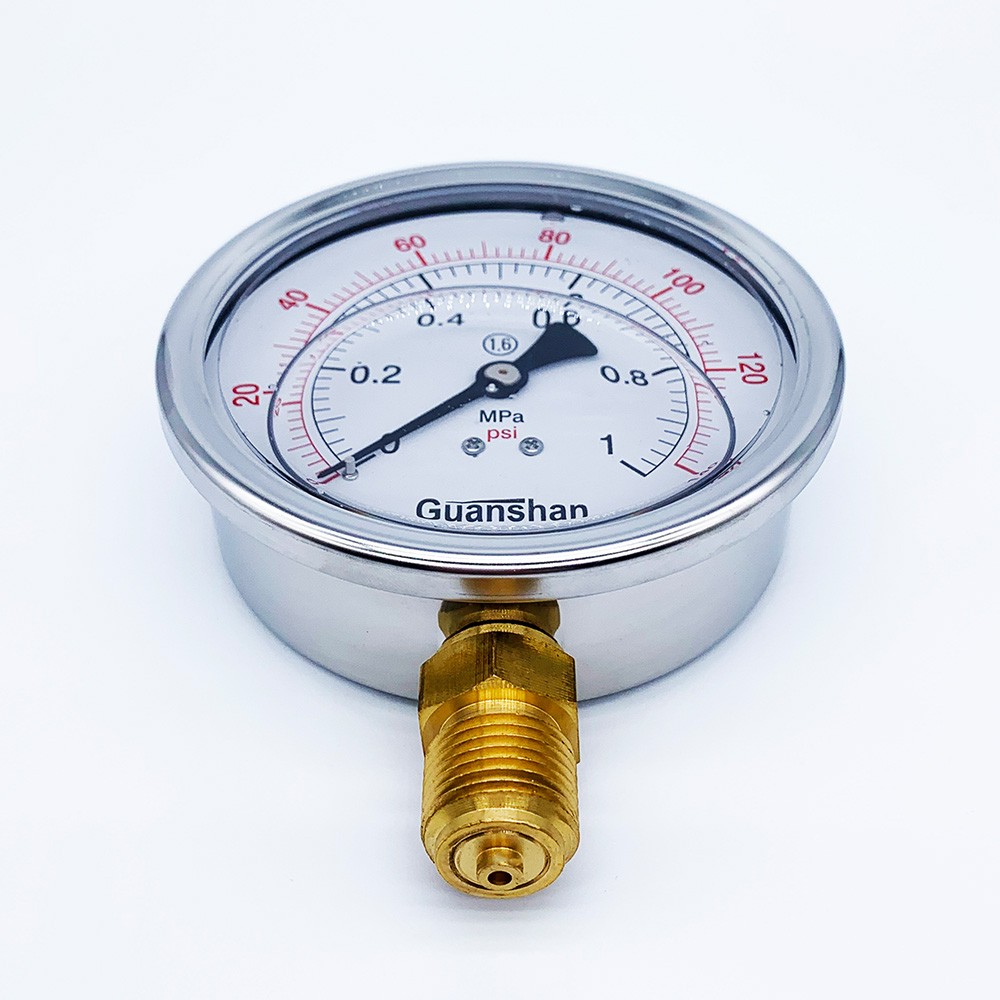
Wholesale Vacuum Gauge Glycerine Filled - PG-L-04-4
Product Details
| Model | PG-L-04-4 |
|---|---|
| Description | Liquid filled pressure gauge |
| Nominal size in mm | 100 |
| Accuracy class | 1.6 |
| Scale ranges | -1~600bar |
| Permissible temperature | Ambient: -5~60℃ / Medium: 60℃ |
| Process connection | Copper alloy |
| Connection thread | 1/2 (G PT NPT) |
| Bourdon tube | Phosphor Bronze |
| Movement | Copper alloy |
| Case | S.S case |
| Bezel | S.S Rolling |
| Window | PC |
| Dial | Aluminum (customized logo) |
| Pointer | Aluminum, black |
Common Product Specifications
| Glycerine Filling | Provides vibration dampening and lubrication |
|---|---|
| Materials | Stainless steel case, phosphor bronze tube |
| Pressure Range | Suitable for -1 to 600 bar |
| Temperature Range | Ambient -5 to 60°C; Medium 60°C |
Product Manufacturing Process
The manufacturing process of glycerine-filled vacuum gauges involves precision engineering to ensure accuracy and reliability. Key steps include the fabrication of the Bourdon tube, which is crafted from phosphor bronze for elasticity and pressure responsiveness. The casing, typically made of stainless steel, is assembled to house the internal components securely. Glycerine is carefully filled into the gauge to ensure consistent dampening effects. Quality control measures, such as pressure testing and calibration, are critical to meet industry standards. Studies indicate that integrating glycerine significantly enhances gauge lifespan and operational accuracy under dynamic conditions.
Product Application Scenarios
Glycerine-filled vacuum gauges are widely used in various industries due to their robust design and reliable performance. In the automotive sector, these gauges help maintain vacuum pressure in brake systems. They are pivotal in the HVAC industry for effective system diagnostics and maintenance. In industrial manufacturing, particularly in chemical and pharmaceutical sectors, maintaining vacuum levels is crucial for process integrity. Research supports their efficacy in high-vibration environments, providing stable readings and prolonging instrument life, making them indispensable in demanding operational settings.
Product After-Sales Service
Guanshan Instruments offers comprehensive after-sales support for our wholesale vacuum gauge glycerine filled products, including repair services and technical assistance. We provide a warranty that covers manufacturing defects and offer replacement parts to ensure long-term performance and customer satisfaction. Our dedicated support team is available to address any product-related inquiries and provide guidance to optimize the use of our pressure gauges.
Product Transportation
Our wholesale vacuum gauge glycerine filled products are securely packaged for transportation to ensure they reach you in perfect condition. We partner with reliable logistics providers to offer timely delivery across various regions, adhering to regulatory standards for the safe transport of industrial equipment.
Product Advantages
- Durability: Robust construction for long-term use in industrial applications.
- Accuracy: Precise measurements with a 1.6 accuracy class.
- Vibration Resistance: Glycerine filling reduces needle fluctuations in dynamic environments.
- Moisture Protection: The filled design prevents moisture ingress improving reliability.
Product FAQ
- What is a vacuum gauge glycerine filled? A vacuum gauge glycerine filled is an instrument designed to measure and display negative pressure levels relative to atmospheric pressure, commonly used in various industrial applications due to its enhanced stability and accuracy.
- Why is glycerine used in these gauges? Glycerine is used in vacuum gauges to dampen vibrations, lubricate internal parts to reduce wear, and protect against moisture and contamination, thereby extending the gauge's lifespan and improving performance.
- Can the gauges handle high-pressure environments? Yes, these gauges are designed to handle high dynamic pressure environments due to the glycerine filling, which absorbs pressure spikes that might otherwise damage the instrument.
- What industries commonly use vacuum gauge glycerine filled? Industries such as HVAC, automotive, industrial manufacturing, and laboratory research commonly use these gauges for precise monitoring and control of vacuum levels.
- How do I ensure long-term accuracy of my gauge? Regular calibration and maintenance, as advised by the manufacturer, are essential to maintain the accuracy and reliability of your gauge in service.
- Are there different sizes available? Yes, our gauges come in multiple sizes to accommodate various applications, with the nominal size for this model being 100 mm.
- What temperature ranges can these gauges operate in? These gauges can operate in ambient temperatures ranging from -5 to 60°C and medium temperatures up to 60°C.
- Is it possible to customize the gauge’s dial? Yes, we offer customization options for the dial, including logo placement and specific measurement scales as per client requirements.
- What are the shipping options available? We offer a variety of shipping options tailored to meet regional and international logistical needs, ensuring timely delivery of orders.
- What warranty do you offer for these gauges? We provide a comprehensive warranty that covers manufacturing defects, with an option for extended service plans and support for wholesale purchases.
Product Hot Topics
- Vibration Dampening in Vacuum Gauge Design - Vibration dampening is a critical aspect in the design of vacuum gauges, particularly those filled with glycerine. In high-pressure environments, vibrations can lead to significant fluctuations in readings, threatening both precision and gauge longevity. By incorporating glycerine, the internal components are cushioned, allowing for a stable needle movement and more reliable readings. This design choice not only enhances accuracy but also extends the device's service life, making glycerine-filled vacuum gauges a preferred choice in various demanding industrial settings.
- Importance of Glycerine in Vacuum Gauges - Glycerine serves multiple purposes in vacuum gauges, acting as a lubricant while mitigating the effects of environmental factors such as moisture and contaminants. This multipurpose role helps the instrument maintain its accuracy and reliability over time, especially under conditions of high vibration or pressure spikes. For industries that rely on precise vacuum measurements, such as HVAC or pharmaceuticals, the inclusion of glycerine in gauge design is essential, underlining its importance in modern instrumentation.
- Advancements in Pressure Measurement Technology - Recent advancements in pressure measurement technologies have highlighted the effectiveness of glycerine-filled gauges. These advances focus on improving the materials and mechanics to boost overall performance. For instance, the use of enhanced corrosion-resistant materials in the casing and improved sealing techniques further protect the gauge from harsh operational environments, ensuring consistent performance. The integration of glycerine is pivotal to these advancements, offering unmatched durability and accuracy.
- Comparative Analysis: Glycerine-Filled vs. Dry Gauges - When comparing glycerine-filled vacuum gauges to their dry counterparts, the former offers superior performance in high-dynamic environments. While dry gauges are suitable for static applications, they often fall short in dynamic situations where vibration and shock are prevalent. The glycerine filling acts as a buffer, maintaining stability and preventing transient oscillations. This makes glycerine-filled gauges the preferred choice for industries requiring reliable and precise pressure readings.
- Customizing Vacuum Gauges for Specific Applications - Customization in vacuum gauge design is growing in demand, with businesses seeking tailored solutions to fit specific operational requirements. Customizable features include dial designs, measurement scales, and connection sizes, which adapt to a variety of industrial setups. Glycerine-filled vacuum gauges offer the flexibility manufacturers need to customize solutions that precisely match customer needs, enhancing usability and functionality across diverse applications.
- Glycerine-Filled Gauges in Automotive Industry Applications - In the automotive sector, maintaining precise vacuum levels is critical for systems such as emissions controls and brake boosters. Glycerine-filled gauges provide the necessary reliability and accuracy required in these systems. Their ability to dampen vibrations and protect against sudden pressure changes ensures that vehicle systems remain safe and efficient under various operating conditions, highlighting their importance in automotive applications.
- Evaluating the Durability of Glycerine-Filled Gauges - The durability of glycerine-filled vacuum gauges is a key advantage, particularly in harsh environments. The filling not only protects internal components from moisture and contaminants but also reduces mechanical wear and tear. This resilience translates to lower maintenance costs and longer service intervals, offering businesses a cost-effective solution for long-term pressure measurement needs.
- Applications of Glycerine-Filled Gauges in Laboratories - Laboratories conducting sensitive experiments often require precise vacuum control. Glycerine-filled gauges are critical in these settings due to their high accuracy and ability to withstand environmental variables. They ensure that experiments are conducted under stable conditions, providing researchers with reliable data and contributing to successful experimental outcomes.
- Future Trends in Vacuum Gauge Design - As industries evolve, so do the requirements for precision instruments like vacuum gauges. Future trends may include integration with digital readouts and smart technologies that offer real-time data analysis and remote monitoring capabilities. These developments will likely continue to incorporate glycerine for stability, ensuring that gauges remain effective in increasingly complex industrial landscapes.
- Choosing the Right Vacuum Gauge for Your Needs - Selecting the right vacuum gauge involves considering factors such as the operational environment, required accuracy, and specific application needs. Glycerine-filled gauges are particularly beneficial in environments subject to vibration and dynamic pressures. By understanding these factors, businesses can make informed decisions to select gauges that provide the best fit for their operational requirements, ensuring both performance and economic efficiency.
Image Description
There is no picture description for this product
 Privacy settings