

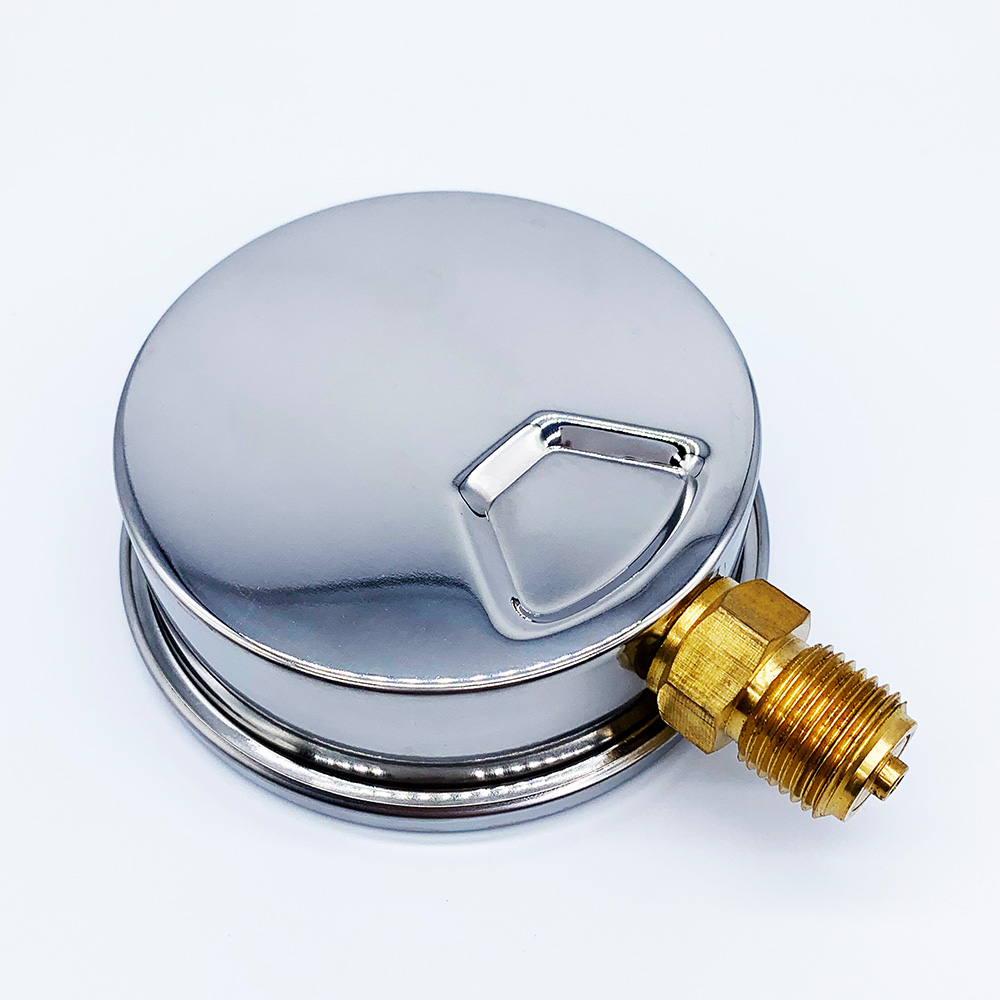
Non-Liquid Filled Fuel Pressure Gauge Manufacturer
Product Details
| Nominal Size | 100 mm |
| Accuracy Class | 1.6 |
| Scale Ranges | -1~600 bar |
| Permissible Temperature | Ambient: -5~60℃, Medium: 60℃ |
| Process Connection | Copper Alloy |
| Connection Thread | 1/2 (G PT NPT) |
| Bourdon Tube | Phosphor Bronze |
| Movement | Copper Alloy |
| Case | Stainless Steel |
| Bezel | Stainless Steel Rolling |
| Window | PC |
| Dial | Aluminum (customized logo) |
| Pointer | Aluminum, black |
Common Product Specifications
| ... |
Product Manufacturing Process
The manufacturing of non-liquid filled fuel pressure gauges involves precision engineering to ensure durability and accuracy. These gauges start with the assembly of a Bourdon tube, which requires careful bending and attachment to a movement mechanism. Components are typically made from stainless steel or brass to withstand various operating conditions. The casing and face are then assembled, ensuring full protection against dust and moisture. Each gauge undergoes rigorous testing for accuracy under simulated conditions, including vibration and pressure variations, to ensure reliability. As a reputable manufacturer, aligning with standards like ISO 9001 is crucial to maintain quality. Emphasis on quality control throughout production ensures the product meets industry expectations and customer needs.
Product Application Scenarios
Non-liquid filled fuel pressure gauges are employed extensively in scenarios requiring swift response times and cost-efficiency. Their primary applications include automotive engines, where monitoring fuel pressure is crucial for performance and safety. Moreover, they are preferred in industrial settings, particularly where vibrations are minimal. These gauges are favored in cold environments due to their resistance to freezing, unlike liquid-filled counterparts. As a leading manufacturer, we ensure that these gauges address challenges in diverse settings while maintaining functionality. Their use in environments where rapid pressure changes occur highlights their importance in maintaining operational efficiency and safety.
Product After-Sales Service
Our company offers comprehensive after-sales service, including calibration support, technical assistance, and product repair or replacement options to ensure customer satisfaction. A dedicated team is available to address any concerns and provide expert guidance on gauge usage and maintenance. Customers can contact us via email or phone for support.
Product Transportation
We ensure that our non-liquid filled fuel pressure gauges are packaged securely to prevent damage during transit. Our logistics team works with reputable carriers to guarantee timely delivery worldwide. Tracking options are available for all shipments to provide customers with real-time updates on their order status.
Product Advantages
- Cost-effective
- Quick response time
- High temperature tolerance
- Low maintenance
- Reliable performance in diverse environments
Product FAQ
- What materials are used in manufacturing the gauge?
Our non-liquid filled fuel pressure gauges are constructed using high-quality materials, typically stainless steel and brass, ensuring durability and resistance to various environmental conditions. As a recognized manufacturer, we prioritize the use of robust components to maintain product longevity and performance.
- How often should the gauge be calibrated?
Calibration frequency depends on the gauge's usage and operating environment. However, we recommend annual calibration to maintain accuracy and ensure reliable readings. Our after-sales service team can provide guidance on proper calibration and usage techniques specific to your application.
- ...
Product Hot Topics
- The Role of Non-Liquid Filled Fuel Pressure Gauges in Industrial Automation
As industrial automation advances, the need for reliable monitoring devices such as non-liquid filled fuel pressure gauges becomes critical. These gauges offer rapid response times and cost-effectiveness, making them ideal for applications where budgetary constraints are significant. Despite their lack of damping, which makes them more susceptible to vibrations, their advantages in terms of simplicity, maintainability, and performance make them a preferred choice for many manufacturers. Their adaptability to varying temperatures without the risk of liquid freezing further underscores their applicability in different industrial settings. As a prominent manufacturer, our commitment to supplying high-quality gauges aligns with the sectors' ongoing evolution, ensuring that our equipment meets the necessary standards and expectations.
- ...
Image Description
There is no picture description for this product
 Privacy settings