
The detection principle and advantages of SF6 gas detector

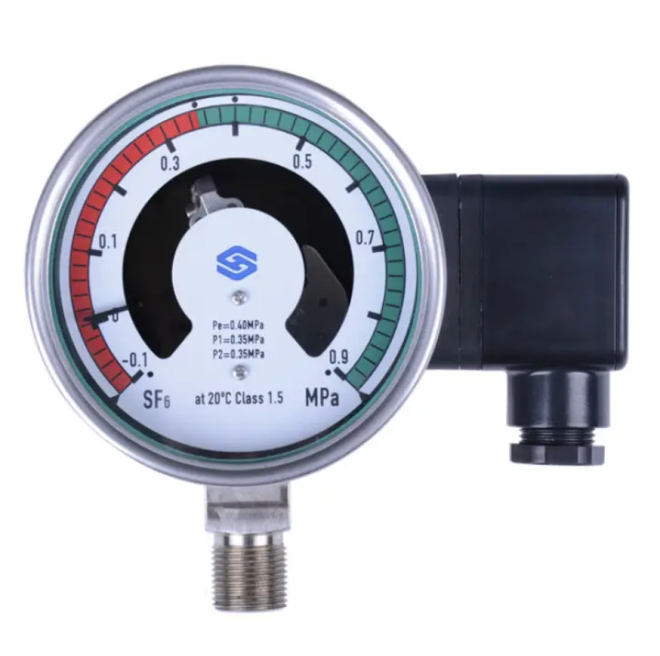
In the monitoring process of SF6 gas density monitor, the gas pressure enclosed in the container changes with temperature. In order to have a unified standard for comparison, we usually use the relative pressure value of 20 ℃ as the standard value. When verifying it, the measured pressure is converted into an equivalent pressure value at 20 ℃ based on the correspondence between pressure and temperature, and then compared.
- Lock recovery value verification: When the instrument pointer is at zero position, slowly and uniformly inflate the relay. When it sends out a lock action, record the pressure value at the ambient temperature at that time and convert it into the equivalent pressure value at 20 ℃. This equivalent pressure value is its lock recovery value.
- Alarm response value verification: Slowly and uniformly inflate the instrument. When it emits an alarm action, record the pressure value at the ambient temperature and convert it into the equivalent pressure value at 20 ℃. This equivalent pressure value is its alarm response value.
- Verification of overpressure recovery value: Slowly and uniformly inflate the SF6 gauge. When it sends out an overpressure signal, slowly and uniformly deflate the instrument. When the relay overpressure alarm signal is issued, record the pressure value at the ambient temperature and convert it into the equivalent pressure value at 20 ℃. This equivalent pressure value is its overpressure recovery value.
- Alarm value verification: When the pressure value inside the instrument is higher than the alarm response value at ambient temperature, it begins to slowly release gas at a constant speed. When the SF6 density relay sends an alarm signal, the pressure value at the ambient temperature is recorded and converted to the equivalent pressure value at 20 ℃. This equivalent pressure value is its alarm value.
- Lock value verification: Slowly and uniformly release the gas to the instrument. When it sends a lock signal, record the pressure value at the ambient temperature and convert it into the equivalent pressure value at 20 ℃. This equivalent pressure value is its lock value.
- Overpressure value verification: Slowly and uniformly inflate the instrument. When the SF6 density relay sends an overpressure signal, record the pressure value at the ambient temperature and convert it into an equivalent pressure value at 20 ℃. This equivalent pressure value is its overpressure value.
The above are six calibration methods for SF6 gas detectors, which are also a reflection of their working principles. They can be applied to detect hazardous gas leakage places. Imported electrochemical/catalytic combustion sensors are used, which have the advantages of stable signal and high accuracy. The explosion-proof wiring method is suitable for various hazardous places.In the power industry, high-voltage switchgear and substations use SF6 gas as the insulation medium to ensure stable operation of equipment under high voltage. Therefore, the concentration and quality of SF6 gas are important indicators for the operation and maintenance of power equipment.
 Privacy settings