

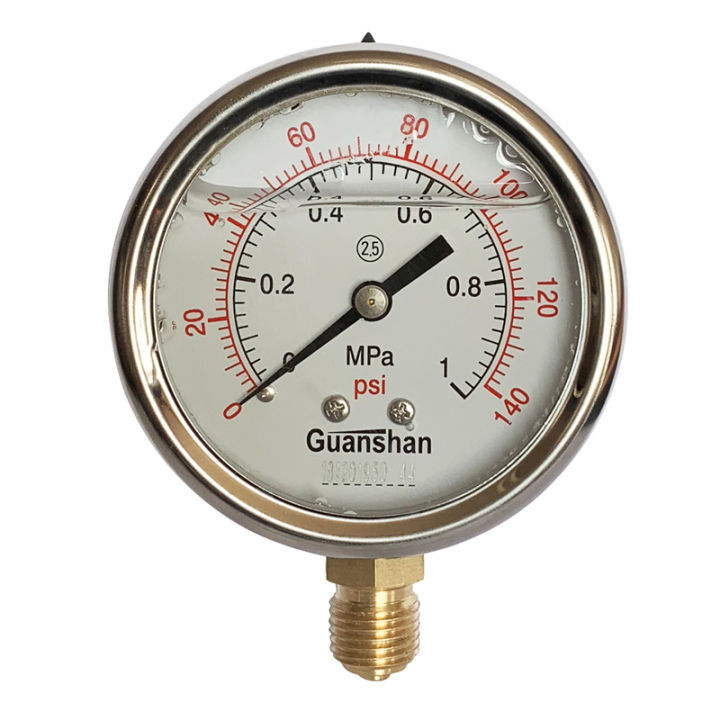
Factory WIKA Liquid Filled Gauges - PG-L-01-2.5
Product Details
| Model | PG-L-01 |
|---|---|
| Description | Liquid filled pressure gauge |
| Nominal size in mm | 63 |
| Accuracy class | 1.6 or 2.5 |
| Scale ranges | -1~600 bar |
| Permissible temperature | Ambient: -5~60℃, Medium: 60℃ |
| Process connection | Copper alloy |
| Connection thread | 1/4 (G PT NPT) |
| Bourdon tube | Phosphor Bronze |
| Movement | Copper alloy |
| Case | S.S case |
| Bezel | S.S Rolling |
| Window | PC |
| Dial | Aluminum (customized logo) |
| Pointer | Aluminum, black |
Common Product Specifications
| Material | Stainless Steel |
|---|---|
| Filling Liquid | Glycerin |
| Pressure Range | -1 to 600 bar |
| Operating Environment | -5 to 60℃ (Ambient) |
Product Manufacturing Process
According to authoritative papers, the manufacturing of liquid-filled pressure gauges involves precise machining and calibration processes to ensure accuracy and reliability. The process typically starts with the forming of the Bourdon tube, which is the core sensing element. Next, components such as the movement, which is crucial for accurate readings, are assembled carefully. The gauges undergo rigorous testing under simulated conditions to ensure they withstand vibrations and pressure spikes. The final stage includes the filling of liquid, usually glycerin, which is done in a controlled environment to prevent contamination. As concluded, maintaining strict quality control during manufacturing ensures the gauges' durability and precision.
Product Application Scenarios
Based on authoritative studies, WIKA liquid-filled gauges are extensively used across various industrial sectors. In the oil and gas industry, these gauges are essential for drilling and refining operations where equipment must endure harsh conditions. In chemical processing plants, they provide reliable pressure measurement amidst potential exposure to corrosive chemicals. Manufacturing industries utilize these gauges for machinery monitoring, ensuring stability and accuracy despite high vibrations. Additionally, they play a critical role in water treatment facilities, both in clean and wastewater systems, where their longevity and accuracy prove beneficial. Conclusively, these gauges are indispensable in environments demanding robust and precise pressure measurement solutions.
Product After-Sales Service
Our commitment to customer satisfaction extends beyond the sale. We offer comprehensive after-sales services including technical support, warranty coverage, and maintenance advice to ensure the optimal performance of our factory WIKA liquid-filled gauges. Our dedicated team is available to assist with troubleshooting and repairs, guaranteeing that your gauges continue to meet your operational needs over time.
Product Transportation
Understanding the importance of safe delivery, our logistics team ensures that all factory WIKA liquid-filled gauges are packed securely with protective materials to minimize the risk of damage during transit. We collaborate with trusted shipping partners to provide timely delivery to both domestic and international locations, ensuring your gauges reach you in perfect condition.
Product Advantages
- Vibration Dampening
- Shock Resistance
- Corrosion Protection
- Enhanced Readability
- Longevity
Product FAQ
- Why are liquid-filled gauges preferred in industrial settings? Factory WIKA liquid-filled gauges are favored for their ability to dampen vibrations and absorb shocks, ensuring accurate readings in high-stress environments.
- What liquids are used in the gauges? Our factory WIKA liquid-filled gauges typically use glycerin or silicone, which provide excellent damping and lubrication for internal components.
- How do liquid-filled gauges resist corrosion? The liquid filling creates a barrier that prevents moisture and contaminants from reaching the internal components, preserving the gauge's integrity.
- Are these gauges suitable for extreme environments? Yes, our factory WIKA liquid-filled gauges are designed to withstand harsh conditions, including temperature fluctuations and corrosive surroundings.
- What maintenance do these gauges require? Regular inspection of the liquid level and condition, along with checking for leaks or physical damage, is recommended to keep the gauges functioning optimally.
- Can these gauges handle rapid pressure changes? Absolutely. The liquid filling absorbs pressure spikes, protecting the gauge's mechanical parts and ensuring consistent performance.
- What are the benefits of glycerin-filled gauges? Glycerin provides excellent damping and is suitable for most applications, making it a popular choice for factory WIKA liquid-filled gauges.
- How do I select the right gauge for my application? Consider factors like pressure range, connection type, and environmental conditions when choosing a factory WIKA liquid-filled gauge.
- How does the liquid filling enhance visibility? The liquid reduces internal condensation, keeping the lens clear for easy reading, especially in humid or temperature-variable environments.
- What is the warranty on these gauges? Our factory WIKA liquid-filled gauges come with a standard warranty period, during which we offer repairs or replacements for any manufacturing defects.
Product Hot Topics
- Importance of Vibration Dampening in Industrial Gauges The factory WIKA liquid-filled gauges are widely acclaimed for their superior vibration-dampening capabilities. In industrial applications, machines often operate in high-vibration environments that can affect the accuracy of readings. The liquid filling in these gauges dampens the effects of vibrations, ensuring that the needle remains stable for precise pressure monitoring. This feature not only enhances measurement reliability but also extends the operational lifespan of the gauge, making it a cost-effective choice for businesses. By investing in these advanced gauges, companies can reduce maintenance costs and improve process efficiency.
- Resilience to Extreme Conditions: A Key Advantage Factory WIKA liquid-filled gauges are engineered to thrive in extreme conditions where standard gauges may falter. Their robust design allows them to withstand rapid pressure changes and temperature variations, making them ideal for use in challenging environments such as oil refineries and chemical plants. The liquid fill not only cushions against shock but also acts as a barrier against moisture and corrosive substances, protecting internal components from damage. As a result, these gauges maintain accuracy and reliability even under harsh conditions, ensuring continuous operation and safety in critical systems.
Image Description
There is no picture description for this product
 Privacy settings