

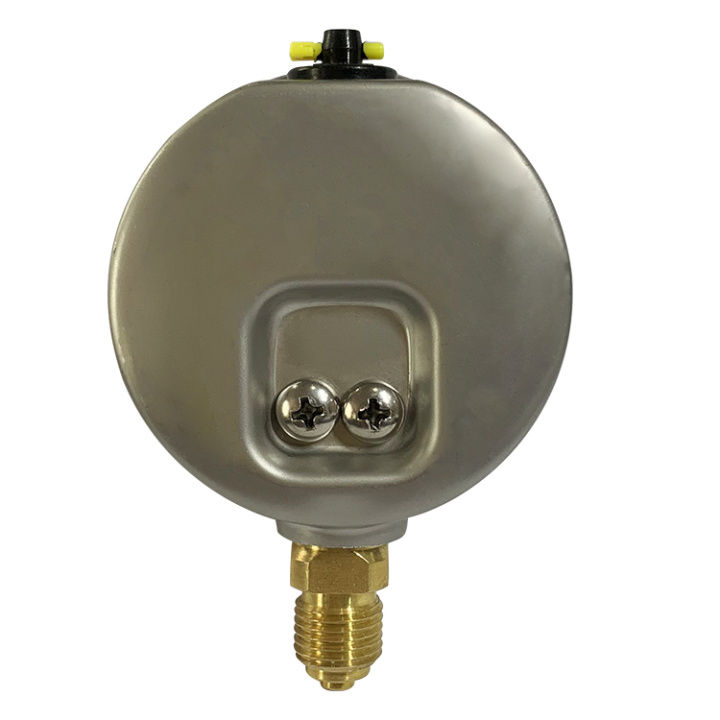
Factory-Grade Liquid Gauge for Precision Monitoring
Product Main Parameters
| Model | PG-L-06 |
|---|---|
| Description | Liquid filled pressure gauge |
| Nominal size in mm | 63 |
| Accuracy class | 1.6 or 2.5 |
| Scale ranges | -1~600bar |
| Permissible temperature | Ambient: -5~60℃ Medium: 60℃ |
| Process connection | Copper alloy |
| Connection thread | 1/4 (G PT NPT) |
| Bourdon tube | Phosphor Bronze |
| Movement | Copper alloy |
| Case | S.S case |
| Bezel | S.S Rolling |
| Window | PC |
| Dial | Aluminum (customized logo) |
| Pointer | Aluminum, black |
Common Product Specifications
| Category | Pressure gauge |
|---|---|
| Medium Compatibility | Gaseous and liquid, non-viscous, non-crystallising |
| Pressure Load Suitability | High dynamic loads |
| Industries Served | Hydraulics, compressors, shipbuilding |
Product Manufacturing Process
The manufacturing process of liquid gauges involves several critical steps to ensure precision and reliability. Initially, high-quality materials such as copper alloy and phosphor bronze are selected for their durability and resistance to corrosion. Advanced machining and fabrication techniques are employed to create precise components such as the Bourdon tube and the movement. The assembly of these parts is conducted in controlled environments to maintain high standards of accuracy. Rigorous testing and calibration are performed to ensure each gauge meets the specified accuracy class. The final product is inspected and verified for performance consistency. This meticulous process ensures that the liquid gauges produced are of the highest quality and can reliably serve in demanding industrial applications.
Product Application Scenarios
Liquid gauges are indispensable in various industrial sectors where accurate liquid level measurement is critical. In chemical processing plants, they are used to maintain optimal chemical mixtures and prevent potentially hazardous overflows. In water treatment facilities, liquid gauges facilitate the monitoring of water levels to ensure efficient processing and safe operations. The petroleum industry relies on these gauges for inventory management and spill prevention in storage tanks. Additionally, in the food and beverage industry, they help in maintaining consistent quality and proper ingredient ratios. Across these applications, liquid gauges enhance operational efficiency, safety, and product quality.
Product After-Sales Service
We provide comprehensive after-sales support including warranty services, maintenance assistance, and technical guidance to ensure our customers have a seamless experience with our liquid gauges. Our dedicated support team is readily available to address any queries or issues that may arise post-purchase and ensure the longevity and optimal performance of our products.
Product Transportation
Our liquid gauges are securely packaged and shipped to prevent damage during transit. We partner with reliable logistics providers to ensure timely and safe delivery to both domestic and international destinations. Customers can track their orders online, ensuring complete transparency in the delivery process.
Product Advantages
- High accuracy and reliability in various applications.
- Durable construction using premium materials for long service life.
- Wide range of model options and customizations available.
- Compliant with international quality standards.
- Continuous innovation and technology integration for enhanced performance.
Product FAQ
- Q: What type of liquid gauge is best for highly viscous liquids?
A: For highly viscous liquids, consider using a hydrostatic pressure gauge as it measures pressure at the bottom of the tank, providing an indirect yet accurate measurement of the liquid level. It's crucial to ensure the gauge material is compatible with the liquid to avoid corrosion or damage. - Q: Can liquid gauges be used in high-temperature environments?
A: Yes, many liquid gauges, including our factory-grade models, are designed to withstand high temperatures. It's essential to check the permissible temperature range for each specific gauge model to ensure compatibility with your operational conditions. - Q: How often should liquid gauges be calibrated?
A: Calibration frequency depends on the application and requirements for accuracy. Typically, annual calibration is recommended to maintain optimal performance, but critical applications may require more frequent checks. - Q: Are your gauges suitable for outdoor installation?
A: Our gauges are built to withstand various environmental conditions, including outdoor installations. However, it is advisable to ensure additional protection against extreme weather or corrosive environments to prolong the gauge's life. - Q: What maintenance is required for liquid gauges?
A: Regular maintenance involves visual inspections to check for physical damage, verifying the calibration, and ensuring that connections are secure. Proper handling during use can significantly prolong the gauge's lifecycle. - Q: How do liquid gauges integrate with automated systems?
A: Many modern liquid gauges come with compatible interfaces or communication protocols that allow them to be integrated into automated monitoring and control systems, providing real-time data and enhancing operational efficiency. - Q: What options are available for customizing liquid gauges?
A: Customization options include scale range selection, dial logo branding, connection thread types, and material choices for components, allowing for tailored solutions to meet specific needs. - Q: Can I use the same gauge for gas and liquid applications?
A: While some gauges are versatile for both gases and liquids, it is crucial to ensure that the gauge materials are compatible with the media to avoid damage and maintain accuracy. - Q: How does factory assembly ensure gauge quality?
A: Factory assembly follows stringent quality control measures, utilizing precision manufacturing techniques and thorough testing to ensure that each gauge meets industry standards for performance and reliability. - Q: What should I do if my gauge shows inaccurate readings?
A: If a gauge shows inaccurate readings, first verify calibration and check for physical obstructions or damage. If the problem persists, consult with our support team for further assistance and potential repairs.
Product Hot Topics
- Topic: Integrating Liquid Gauges into Modern Industrial Systems
Discussion: As industries advance towards greater automation, the integration of liquid gauges into centralized systems has become a hot topic. The ability of these gauges to provide real-time data makes them invaluable for process optimization and safety assurance. Many factories are now leveraging smart sensor technology within liquid gauges to improve decision-making processes and boost operational efficiency. Additionally, the move towards IoT-enabled devices has further enhanced the role of liquid gauges, making them a crucial component in the future landscape of industrial automation. - Topic: The Role of Material Science in Liquid Gauge Durability
Discussion: The choice of materials in manufacturing liquid gauges has a substantial impact on their performance and longevity. Advances in material science have allowed for the development of more robust and corrosion-resistant gauges, suitable for harsh environments. As factories seek to ensure reliability in diverse applications, the focus on material selection has become more critical than ever. With continuous research and breakthroughs in alloys and composites, factories are now able to offer gauges that not only provide precise measurements but also withstand challenging operational conditions over extended periods. - Topic: Achieving Precision: Calibration Techniques for Liquid Gauges
Discussion: Calibration plays a vital role in achieving precision with liquid gauges, and factories are constantly refining their techniques to ensure accuracy. Calibrating a gauge involves adjusting the measurement output to match a known standard, which is crucial for maintaining performance across various applications. Modern calibration techniques have evolved, incorporating advanced technologies such as laser calibration and digital standards, highlighting the importance of accuracy in industrial processes. - Topic: Choosing the Right Liquid Gauge for Your Application
Discussion: Selecting the right liquid gauge for a specific application involves a thorough understanding of the operational environment and requirements. Factors such as liquid properties, temperature, pressure, and desired accuracy dictate the type of gauge best suited for the task. Factories are now offering a diverse range of gauges with varying specifications, ensuring that every industrial need is met with precision and reliability. Customers must evaluate these factors carefully to optimize their operations and ensure safety and efficiency. - Topic: Environmental Considerations in Liquid Gauge Manufacturing
Discussion: The manufacturing of liquid gauges, like many industrial processes, carries environmental considerations. Factories are increasingly adopting sustainable practices to minimize their ecological footprint. This includes using eco-friendly materials, optimizing manufacturing processes to reduce waste, and recycling components. As environmental regulations become more stringent, the industry is focused on developing greener manufacturing solutions, which not only benefit the planet but also enhance the brand reputation of companies committed to sustainability. - Topic: Technological Innovations in Liquid Gauge Design
Discussion: Liquid gauge design has seen significant technological advancements, leading to more precise and reliable products. Recent innovations include the integration of advanced sensors, digital displays, and wireless connectivity. These enhancements enable better data collection and analysis, providing factories with vital insights into their operations. As technology continues to evolve, the potential for even greater improvements in liquid gauge design remains vast, promising exciting developments in the field. - Topic: Addressing Common Challenges in Liquid Level Measurement
Discussion: Industries face several challenges when measuring liquid levels, including dealing with viscous media, varying temperatures, and pressure fluctuations. Liquid gauges are designed to address these challenges through durable construction, precise calibration, and advanced sensor technology. Factories are committed to continuous innovation, ensuring their gauges can handle the most demanding conditions while providing accurate and reliable readings. - Topic: Enhancing Operational Efficiency with Smart Liquid Gauges
Discussion: The adoption of smart liquid gauges has revolutionized how factories manage their processes. These gauges offer advanced features like real-time monitoring, remote access, and integration with automated systems. By providing instant data on liquid levels and conditions, factories can make informed decisions swiftly, optimizing their operations and minimizing downtime. The shift towards smart technology represents a significant leap forward in industrial efficiency and control. - Topic: Liquid Gauge Maintenance: Best Practices for Longevity
Discussion: Regular maintenance is crucial for the longevity of liquid gauges, ensuring they deliver accurate readings over time. Best practices include periodic calibration, thorough inspections for physical damage, and routine cleaning of components. Factories provide detailed maintenance guidelines to help users keep their gauges in peak condition. By following these practices, industries can maximize the lifespan of their equipment, enhancing both safety and operational efficiency. - Topic: Understanding the Importance of Liquid Gauge Accuracy
Discussion: Accuracy in liquid gauge readings is paramount for maintaining process integrity and safety in industrial applications. Inaccurate measurements can lead to costly errors, operational disruptions, and safety hazards. Factories emphasize the importance of accuracy by implementing rigorous quality control measures and adopting the latest calibration technologies. By understanding the critical role of accuracy, industries can ensure their processes run smoothly and efficiently, safeguarding both resources and personnel.
Image Description
There is no picture description for this product
 Privacy settings