

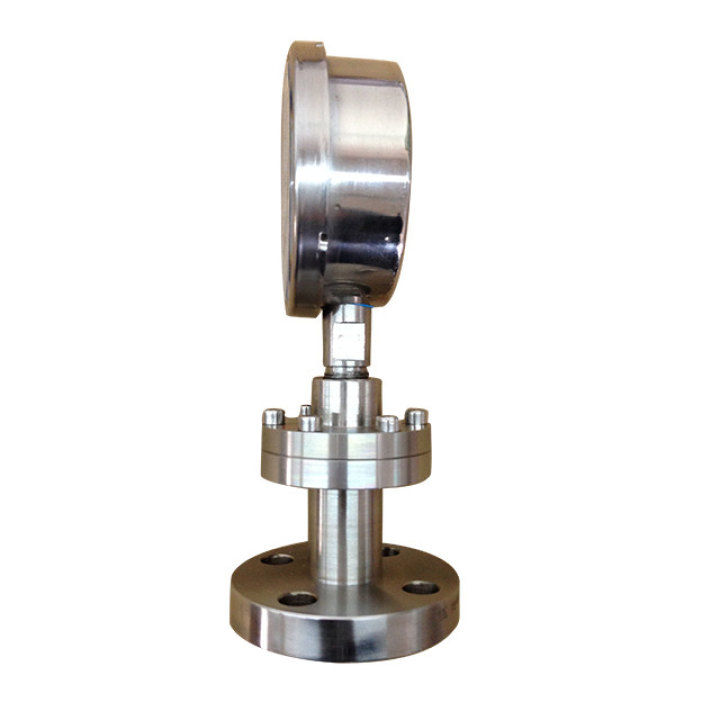
Factory-Grade Liquid Filled Pressure Gauge for Industrial Use
Product Main Parameters
| Model | PG-D-04 |
| Nominal size in mm | 100 |
| Accuracy class | 1.6 |
| Scale ranges | -1~40 bar |
| Permissible temperature | Ambient: -20~60℃, Medium: 150℃ |
| Process connection | S.S 304 |
| Connection Size | Customized |
| Diaphragm body | S.S 304 or S.S 316L |
| Diaphragm seal | S.S 316L |
| Case | S.S 304 |
| Bezel | S.S 304 |
| Window | PC |
| Dial | Aluminum (customized logo) |
| Pointer | Aluminum, black |
Common Product Specifications
| Usage | Industrial, automotive, HVAC, chemical, oil and gas |
| Medium Compatibility | Gases, liquids, pasty, powdery, crystallizing media |
| Material | Stainless steel for durability and corrosion resistance |
| Fill Fluid | Glycerin or silicone for damping |
Product Manufacturing Process
The manufacturing process of factory-grade liquid filled pressure gauges involves precision engineering and strict quality control. Typically, the Bourdon tube is formed and tested for accuracy and resilience. The movement mechanism is assembled carefully to ensure accurate translation of pressure readings. The casing, made from high-quality stainless steel, undergoes rigorous inspection to meet corrosion resistance standards. Upon assembly, the gauges are filled with a damping fluid under controlled conditions to prevent air gaps and ensure uniform pressure response. Lastly, the completed gauges undergo calibration and testing to ensure compliance with industry standards. This meticulous process guarantees a reliable, factory-grade liquid filled pressure gauge that withstands various industrial pressures.
Product Application Scenarios
Factory-grade liquid filled pressure gauges are indispensable in varied industrial settings. Their robust build makes them ideal for use in manufacturing plants where hydraulic systems control machinery like presses and pumps. In the automotive industry, these gauges effectively measure pressure in air brakes and hydraulic clutches, where vibration is a constant. They are also prevalent in chemical processing plants due to their resistance to corrosive materials. Meanwhile, in the oil and gas sectors, these gauges provide accurate readings on rigs and pipelines affected by vibrations and pressure fluctuations. In HVAC systems, they monitor refrigerant pressure, ensuring optimal performance in heating, ventilation, and air conditioning units. This versatility underscores their suitability for harsh factory environments.
Product After-Sales Service
Our company offers comprehensive after-sales service for our factory-grade liquid filled pressure gauge. This includes technical support, necessary repairs, and regular maintenance guidelines to ensure long-term performance. Customers can access our support hotline 24/7 for immediate assistance.
Product Transportation
We ensure safe and efficient transportation of our gauges. Each product is securely packaged to prevent damage during transit. We offer global shipping options, with reliable logistics partners ensuring timely deliveries.
Product Advantages
- High durability and vibration resistance, ideal for factory settings
- Accurate pressure readings across a wide range of media
- Corrosion-resistant materials ensure longevity
- Liquid filling aids in dampening, lubrication, and protection
Product FAQ
- What is the purpose of the liquid fill in the gauge?
The liquid fill in a factory-grade liquid filled pressure gauge serves multiple purposes. Primarily, it dampens vibrations, ensuring a stable pointer reading in high-vibration environments such as factories. The liquid also lubricates internal components, reducing wear and extending the gauge's life. Additionally, it acts as a moisture barrier, preventing condensation inside the gauge, which is especially useful in humid factory conditions.
- Can the gauge be used for both gases and liquids?
Yes, the factory-grade liquid filled pressure gauge is designed to handle both gases and liquids. Its robust construction allows it to operate effectively with various media, including liquid, pasty, powdery, and crystallizing substances. This versatility makes it suitable for diverse industrial applications, ensuring reliable readings regardless of the medium.
- How should the gauge be maintained?
Maintaining a factory-grade liquid filled pressure gauge is straightforward. Regular inspections are recommended to ensure the integrity of the liquid fill and to check for any signs of leakage. Calibration should be performed periodically to maintain accuracy. In factory settings, ensure that the gauge remains free from excessive dust and debris. Proper storage, away from extreme temperatures, also helps prolong its life. Following these maintenance tips will keep the gauge functioning optimally over its service life.
- Are there temperature limitations for this gauge?
Yes, the factory-grade liquid filled pressure gauge has specific temperature limits. The ambient temperature range is -20 to 60°C, with the medium temperature permissible up to 150°C. Exceeding these limits may affect the gauge's performance or cause damage. In particularly cold environments, ensure that the liquid fill does not freeze. In hot conditions, monitor for any signs of fluid expansion or leakage to prevent malfunction.
- What are the common applications of this gauge?
This factory-grade liquid filled pressure gauge is used across various industries. Common applications include monitoring hydraulic pressures in manufacturing plants, measuring system pressures in automotive air brakes and hydraulic clutches, and providing accurate readings in chemical processing plants due to its corrosion-resistant properties. It is also employed in oil and gas pipelines and HVAC systems, evidencing its adaptability to diverse, demanding industrial environments.
- Is the gauge customizable?
Yes, our factory-grade liquid filled pressure gauge offers customization options. Customers can choose specific scale ranges, connection sizes, and even add customized logos on the dial. Our factory specializes in providing tailored solutions to meet diverse industrial needs, ensuring that each gauge fits perfectly into the specific factory application it is intended for.
- What materials are used in the gauge construction?
The factory-grade liquid filled pressure gauge is constructed using high-quality materials for durability and corrosion resistance. The case, bezel, and process connection are made of stainless steel (S.S 304 or S.S 316L), ensuring longevity even in harsh factory environments. The diaphragm seal is also crafted from S.S 316L, known for its resilience against corrosive media, making the gauge suitable for various industrial applications.
- Can this gauge be used in hazardous environments?
This factory-grade liquid filled pressure gauge is built to withstand challenging factory environments, including those with hazardous conditions. Its robust stainless steel construction and liquid-filled design protect it against mechanical shocks, vibrations, and corrosive substances. However, when implementing in hazardous areas, ensure that it complies with specific safety standards and certifications required for such environments to guarantee safe operations.
- What are the advantages of a liquid-filled gauge over a dry gauge?
Factory-grade liquid filled pressure gauges offer several advantages over dry gauges. The liquid fill provides damping, reducing pointer oscillations and enabling stable readings, particularly useful in environments with heavy machinery and vibrations. This fill also acts as a lubricant, lowering wear and extending the gauge's lifespan. Furthermore, it prevents moisture ingress, avoiding internal corrosion and maintaining accuracy. These benefits make liquid-filled gauges preferable in demanding industrial settings.
- How does the factory-grade liquid filled pressure gauge improve operational efficiency?
By providing reliable and accurate pressure readings, the factory-grade liquid filled pressure gauge enhances operational efficiency in industrial applications. Its resilience to vibrations and pulsations ensures consistent performance, reducing downtime caused by equipment malfunction. The gauge's durability minimizes maintenance needs, thus cutting costs and resource expenditure. This contributes to smoother factory operations, allowing for optimized production processes and improved overall efficiency.
Product Hot Topics
- How do liquid-filled gauges enhance accuracy in industrial settings?
In factory environments, where machinery often generates significant vibrations and pulsations, maintaining measurement accuracy is critical. Liquid filled pressure gauges are specifically designed to tackle these challenges. Their liquid fill acts as a damping medium, stabilizing the pointer and preventing fluctuations that can distort readings. This ensures that even in high-vibration settings, such as assembly lines or heavy machinery operations, the gauges provide accurate pressure data. For factory operations, where precision can impact safety and productivity, this reliability makes liquid-filled gauges an invaluable tool.
- Why is stainless steel used in the construction of pressure gauges?
The use of stainless steel in factory-grade liquid filled pressure gauges is integral to ensuring durability and resistance to harsh industrial environments. Stainless steel's inherent properties, such as corrosion resistance, make it suitable for environments where exposure to chemicals or moisture is common. Its strength and resilience also provide protection against mechanical wear and tear, making stainless steel an ideal material for components like the case, bezel, and diaphragm seal. This enhances the longevity of the gauge, ensuring it remains functional and accurate under factory conditions.
- What role does the liquid fill play in maintaining gauge longevity?
The liquid fill in factory-grade liquid filled pressure gauges serves several functions that contribute to the instrument's longevity. By dampening vibrations, the liquid prevents excessive movement of the pointer and internal components, thus reducing mechanical wear over time. It also acts as a lubricant, further minimizing friction-related degradation. Moreover, the liquid seal prevents moisture ingress, protecting internal parts from rust and corrosion, which could otherwise lead to gauge failure. These factors collectively extend the operational lifespan of the gauge, ensuring sustained performance in industrial applications.
- How does the diaphragm pressure gauge differ from standard pressure gauges?
Diaphragm pressure gauges, including factory-grade liquid filled models, offer unique advantages over standard pressure gauges. The diaphragm mechanism allows for precise measurement of low-pressure ranges and is particularly effective with viscous or crystallizing media, which might damage other gauges. The liquid fill enhances this by stabilizing readings in factory environments where vibrations are prevalent. Together, the diaphragm and liquid fill make these gauges particularly suited to applications requiring accurate readings in challenging conditions, such as chemical processing or environments with persistent vibrations.
- Why is accurate pressure measurement crucial in factories?
Accurate pressure measurement in factories is essential for several reasons. It helps ensure the safe operation of equipment, preventing conditions that could lead to mechanical failure or hazards. Precision in pressure readings also contributes to maintaining product quality by ensuring processes operate within specified parameters. This is especially critical in industries such as chemical processing or manufacturing, where deviations could affect safety or lead to costly waste. Reliable gauges, like factory-grade liquid filled models, play a vital role in achieving these operational standards.
- What are the best practices for installing liquid-filled pressure gauges in a factory?
Installing liquid-filled pressure gauges in a factory requires adherence to best practices to ensure accuracy and longevity. Choose an installation location free from excessive heat and far from direct mechanical shocks. Ensure the gauge is level and well-supported to avoid stress on the connection. Regular calibration and inspection are important to maintain accuracy, as is ensuring that the liquid fill remains intact and free from leaks. Following these guidelines helps optimize the gauge's performance and extend its service life in factory conditions.
- Can liquid-filled gauges handle rapid pressure changes effectively?
Yes, factory-grade liquid filled pressure gauges are designed to handle rapid pressure changes effectively. The liquid fill acts as a damping agent, absorbing shocks and smoothing out sudden fluctuations. This capability is critical in environments like hydraulic systems or gas pipelines, where pressures can change rapidly. By providing stable readings, these gauges help maintain operational control and prevent accidental overpressures that could cause system damage or safety hazards.
- How do temperature extremes affect liquid-filled pressure gauges?
Temperature extremes can impact the performance of factory-grade liquid filled pressure gauges. In cold conditions, the liquid fill may thicken or freeze if not properly protected, potentially affecting movement and accuracy. Conversely, high temperatures can cause the liquid to expand, risking leakage and loss of damping properties. To mitigate these effects, use appropriate antifreeze additives in cold environments and ensure the gauge is rated for high-temperature use where needed. Proper selection and maintenance cater to these challenges, ensuring reliable gauge performance in diverse factory settings.
- What maintenance protocols are recommended for optimal gauge performance?
For optimal performance of factory-grade liquid filled pressure gauges, regular maintenance is key. This includes periodic recalibration to ensure measurement accuracy and visual inspections for signs of wear or damage. Check for any leaks or loss of the liquid fill, as this can compromise the gauge's functionality. Cleaning the gauge to remove dust and debris will also prevent operational issues. Adhering to these protocols helps maintain reliable performance, extending the gauge's operational lifespan within factory environments.
- How does the design of a liquid-filled gauge enhance its resilience?
The design of a factory-grade liquid filled pressure gauge inherently enhances its resilience. The liquid fill is central to this, as it not only dampens vibrations but also acts as a seal against moisture ingress, preventing corrosion. The robust materials used, such as stainless steel for the case and diaphragm, provide additional protection against environmental factors. These design elements collectively ensure that the gauge remains functional and accurate, even in the demanding conditions often found in factory applications.
Image Description
There is no picture description for this product
 Privacy settings