

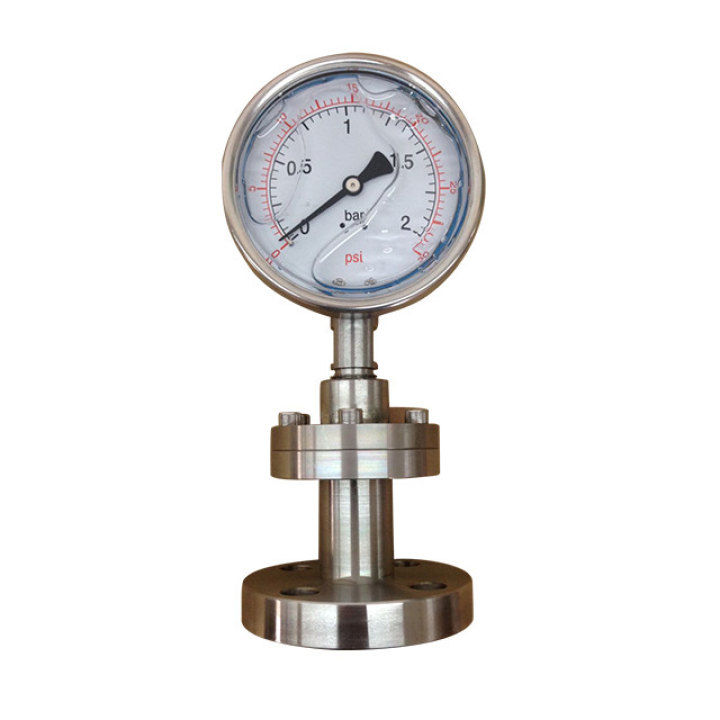
Factory Designed Remote Seal Diaphragm Pressure Gauge
Product Main Parameters
| Model | PG-D-04 |
|---|---|
| Description | Diaphragm pressure gauge |
| Nominal size in mm | 100 |
| Accuracy class | 1.6 |
| Scale ranges | -1~40bar |
| Permissible temperature | Ambient: -20~60℃, Medium: 150℃ |
| Process connection | S.S 304 |
| Connection Size | Customized |
| Diaphragm body | S.S 304 or S.S 316L |
| Diaphragm seal | S.S 316L |
| Case | S.S 304 |
| Bezel | S.S 304 |
| Window | PC |
| Dial | Aluminum (customized logo) |
| Pointer | Aluminum, black |
Common Product Specifications
| Material | Stainless Steel |
|---|---|
| Connection Type | Flange or Threaded |
| Pressure Range | -1 to 40 bars |
| Accuracy | Class 1.6 |
| Temperature Range | -20 to 150°C |
Product Manufacturing Process
The manufacturing process of the diaphragm pressure gauge with remote seal technology involves precision engineering and a deep understanding of materials science. Components are crafted using cutting-edge machinery, ensuring tight tolerances in diaphragm and housing fabrication. The assembly involves welding or securing the diaphragm to its housing, followed by the integration of the capillary and fill fluid. Rigorous quality checks are performed to ensure each gauge meets exacting standards. This expertise in manufacturing allows for customization in material selection and design modifications, as needed, to accommodate varied industrial applications, thereby optimizing performance, reliability, and lifespan.
Product Application Scenarios
Diaphragm pressure gauges with remote seals are widely utilized across industries facing challenging measurement environments. In the chemical and petrochemical industries, they prevent corrosive damage to sensors. The food and beverage industry relies on these gauges to maintain sanitary conditions, ensuring product integrity. Pharmaceutical applications benefit from their ability to provide contamination-free and accurate measurements essential for quality control. In the oil and gas sector, they withstand extreme conditions in both offshore and onshore settings. The power generation industry uses them to safely measure high-pressure steam in boilers and turbines, preventing sensor damage and ensuring operational safety.
Product After-Sales Service
Our factory provides robust after-sales support to ensure customer satisfaction and product performance. The service includes technical support, troubleshooting, and parts replacement. Our team is equipped to provide remote assistance and on-site visits if necessary. Warranty coverage extends for one year, with options for extension available, ensuring your operations remain uninterrupted. Our dedicated support staff is available to address any inquiries and provide solutions swiftly, underlining our commitment to quality and customer satisfaction.
Product Transportation
Transportation of our remote seal diaphragm pressure gauges is handled with care to preserve their integrity and performance. Each unit is securely packaged to prevent damage during transit. We partner with reliable logistics providers, ensuring timely delivery across domestic and international markets. Our packaging complies with industry standards for safety and environmental care. For larger orders, customized logistics solutions are available to meet specific client needs, ensuring a seamless and efficient delivery process from our factory to your site.
Product Advantages
- Protects sensitive instruments from extreme conditions.
- Prevents sensor contamination in sanitary applications.
- Extends instrument life, reducing maintenance costs.
- Enhances safety by isolating hazardous process fluids.
- Provides flexible installation options.
Product FAQ
- How does a remote seal work?
A remote seal uses a diaphragm to isolate the pressure gauge from the process fluid. Changes in pressure deform the diaphragm, which transmits this deformation to a pressure transmitter via a fill fluid in the capillary tube, providing an accurate pressure reading while protecting the gauge from harsh conditions. - Why choose a diaphragm pressure gauge with remote seal?
Choosing this type offers protection for sensitive instruments against corrosive, extreme temperature, and high vibration environments. It minimizes risk of contamination, extends the instrument's durability, and ensures precise measurements even in challenging scenarios. - Can the gauge be customized for specific needs?
Yes, our factory offers customization options including materials, connection types, and pressure ranges to suit specific industrial requirements. Our design team works closely with clients to deliver tailored solutions that fit unique operational conditions. - How do I maintain a diaphragm pressure gauge?
Regular maintenance involves inspecting the diaphragm and fill fluid for any signs of wear or leakage. It is crucial to follow the manufacturer's guidelines for maintenance, ensuring that the diaphragm and instruments remain free from obstruction and damage for optimal performance. - What industries benefit the most from using this gauge?
Industries such as chemical, petrochemical, pharmaceuticals, food and beverage, and power generation benefit significantly due to harsh processing conditions. The gauge's versatility and protective capabilities make it ideal for these demanding environments. - Is the gauge suitable for all fluid types?
While the gauge is suitable for a wide range of fluids, selection of diaphragm material and fill fluid is critical, depending on the fluid's corrosive nature and temperature. Consultation with our factory experts ensures the right configuration for your specific application. - What is the expected lifespan of the gauge?
The lifespan depends on the operating environment, maintenance, and material selection. Properly maintained and chosen appropriately for the application, these gauges can last many years, offering reliable service in measuring pressure. - How does temperature affect remote seal performance?
Temperature can affect fill fluid dynamics and diaphragm elasticity. Our factory designs gauges with materials that minimize these effects, ensuring accuracy over the specified temperature range. For optimal performance, the gauge should operate within the approved temperature limits. - What are the installation considerations?
Installation needs to account for capillary length and environmental factors such as temperature and vibration. Correct installation ensures accurate readings and extends the lifespan of the equipment. Our support team can guide you through the installation process for best results. - What happens if the gauge is damaged?
In case of damage, contact our factory immediately. We offer comprehensive repair services and can supply replacement parts to minimize downtime. Our after-sales support ensures rapid response and solutions to get your operations back online efficiently.
Product Hot Topics
- Advancements in Remote Seal Technology
The evolution of remote seal technology in pressure measurement continues to enhance industrial processes by offering increased accuracy and reliability in extreme conditions. Innovations focus on improving materials, fill fluids, and seal designs to extend the range of applications and ensure consistent operation across varying environmental conditions. Continuous research and development efforts in factories like ours strive to push the boundaries of what's possible, adapting to the growing demands for safety, precision, and efficiency in modern industries. - Integration of Smart Technology with Pressure Gauges
As industries shift towards smart technologies and IoT integration, pressure gauges with remote seals are not left behind. Factories are beginning to integrate sensors that enable real-time data collection and remote monitoring, allowing for early detection of anomalies and predictive maintenance. This integration is set to revolutionize how industrial processes are monitored and controlled, offering improved operational efficiency, reduced downtime, and enhanced safety. At the core of this transformation is the ability to gather and analyze data remotely, a feature that is being increasingly incorporated into the design of modern pressure gauges.
Image Description
There is no picture description for this product
 Privacy settings