

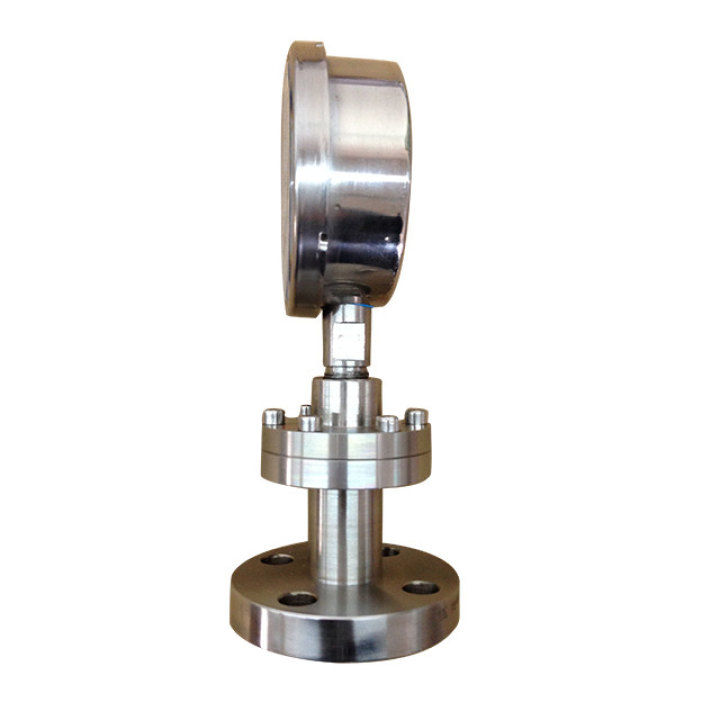
निर्माता द्वारा डायाफ्राम प्रेशर गेज (Diaphragm Pressure Gauge)
Product Main Parameters
| Model | PG-D-04 |
|---|---|
| Nominal size in mm | 100 |
| Accuracy class | 1.6 |
| Scale ranges | -1~40bar |
| Permissible temperature | Ambient: -20~60℃, Medium: 150℃ |
| Process connection | S.S 304 |
| Connection Size | Customized |
| Diaphragm body | S.S 304 or S.S 316L |
| Diaphragm seal | S.S 316L |
| Case | S.S 304 |
| Bezel | S.S 304 |
| Window | PC |
| Dial | Aluminum (customized logo) |
| Pointer | Aluminum, black |
Common Product Specifications
| Usage | For gases, compressed air, vapor; liquid, pasty, powdery and crystallizing media. |
|---|---|
| Industries | Chemical, Food Processing, Pharmaceuticals, Oil & Gas |
Product Manufacturing Process
Diaphragm pressure gauges are manufactured using a precise and controlled process to ensure reliability and accuracy. The process begins with the selection of high-quality materials, such as stainless steel, which are chosen based on their compatibility with different media. The diaphragm, a key component, is formed through a series of mechanical forming and annealing steps to achieve the desired thickness and flexibility. This component is then joined to a sealing surface to ensure accurate pressure measurements. The entire assembly undergoes rigorous quality control checks to ensure that it meets industry standards. The final product is calibrated against certified reference standards to guarantee accuracy and repeatability. Studies have shown that diaphragm pressure gauges manufactured with stringent quality controls deliver enhanced performance in demanding industrial environments.
Product Application Scenarios
Diaphragm pressure gauges are crucial in many industrial settings where traditional gauges may not suffice. They are particularly useful in chemical processing, where they must withstand aggressive media, and in bioreactors, where precise pressure readings are essential for product yield and quality. Their ability to handle low pressures makes them suitable for applications in fermentation and other low-pressure biochemical processes. Additionally, their resistance to corrosive environments allows for use in the oil and gas sector, where they can monitor pressure in harsh, offshore conditions. Studies, such as those published in the Journal of Process Control, indicate that diaphragm pressure gauges are indispensable in environments where safety and precision are paramount.
Product After-sales Service
Our company offers comprehensive after-sales services to ensure customer satisfaction. This includes installation support, routine maintenance, and calibration services to guarantee the ongoing accuracy of your diaphragm pressure gauge. Our dedicated customer service team is available to address any technical issues or concerns you may encounter.
Product Transportation
We ensure safe and efficient transportation of our diaphragm pressure gauges by using secure packaging methods that protect against damage during transit. Our logistics team works with reputable carriers to provide timely delivery globally.
Product Advantages
- Chemical Compatibility: Materials chosen for diaphragm are resistant to specific chemical processes.
- Low Pressure Measurement: Effective for low-pressure systems, capable of measuring down to microbar levels.
- Versatile Use: Suitable for pneumatic and hydraulic systems, ideal for diverse industrial processes.
- High Temperature and Hazardous Media: Operates in high-temperature and potentially harmful environments.
Product FAQ
- What is the main advantage of using a diaphragm pressure gauge?
Diaphragm pressure gauges are beneficial for measuring low pressure accurately and are resistant to corrosive media. They provide precise measurements in challenging environments where other gauges might fail.
- How often should diaphragm pressure gauges be calibrated?
Calibration frequency depends on usage and the environment in which the gauge is used. Typically, annual calibration is recommended, but more frequent calibration may be necessary in critical applications.
- What materials are used in manufacturing the diaphragm?
The diaphragm is commonly made from stainless steel (S.S 304 or S.S 316L) due to its durability and resistance to corrosion. Other materials like Hastelloy or Tantalum may be used depending on application needs.
- Can these gauges be used in food processing industries?
Yes, the materials used in diaphragm pressure gauges are compatible with food-grade applications, making them suitable for food processing industries that require sanitary and hygienic conditions.
- Are diaphragm pressure gauges suitable for high-vibration environments?
Yes, their robust construction allows them to withstand high-vibration environments, ensuring accurate readings despite external disturbances.
- What are the limitations of diaphragm pressure gauges?
While versatile, diaphragm pressure gauges may be more expensive and require regular calibration. Their performance is highly dependent on the material and design of the diaphragm.
- How do diaphragm pressure gauges handle extreme temperatures?
The design and materials of the diaphragm and housing ensure that the gauges can operate in extreme temperatures, providing reliable measurements under such conditions.
- Is customization available for diaphragm pressure gauges?
Yes, we offer customized solutions, including different connection sizes and materials, to meet the specific needs of your application.
- What is the delivery time for a bulk order of diaphragm pressure gauges?
The delivery time varies based on order size and customization requirements. We aim to deliver within 4-6 weeks for standard orders and will provide a specific timeline upon order confirmation.
- How does the diaphragm gauge ensure safety in hazardous environments?
The gauge's design prevents leakage and withstands corrosive and hazardous media, ensuring safe and reliable operation in danger-prone environments.
Product Hot Topics
- Why is the manufacturer important in choosing a diaphragm pressure gauge?
The manufacturer's reputation is crucial because it reflects the quality of the diaphragm pressure gauge. A reliable manufacturer like Guanshan Instruments guarantees stringent quality control, innovation, and reliable after-sales support, ultimately affecting the performance and lifespan of the product. Selecting a reputable manufacturer ensures that you have access to robust, accurate gauges that are capable of performing in diverse applications, including those involving corrosive or hazardous materials.
- How has technology impacted the evolution of diaphragm pressure gauges?
Technological advancements have greatly influenced diaphragm pressure gauges by introducing materials that are more effective and long-lasting. New manufacturing methods have allowed the creation of diaphragms with enhanced sensitivity and accuracy, crucial for precision tasks in modern industries like pharmaceuticals and biotechnology. The integration of smart technology in pressure gauges also allows for better data collection and monitoring, enabling industries to operate with increased efficiency and safety. Manufacturers like Guanshan Instruments are at the forefront of these innovations, ensuring that their products meet the evolving needs of various industries.
- What should industries consider when selecting a diaphragm pressure gauge?
When selecting a diaphragm pressure gauge, industries should consider the media being measured, environmental conditions, required accuracy, and the gauge's compatibility with existing systems. Also, manufacturers' expertise and after-sales support are vital. Industries must assess the chemical compatibility and pressure range to ensure accurate measurements. Additionally, consulting with manufacturers like Guanshan Instruments can provide insight into customization options that may enhance performance for specific applications.
- What role does the diaphragm pressure gauge play in improving process safety?
Diaphragm pressure gauges play a pivotal role in enhancing process safety by providing accurate pressure measurements, which are crucial for monitoring and controlling industrial processes. Maintaining the correct pressure levels is vital to prevent accidents and ensure system integrity. By using high-quality gauges from reputable manufacturers, industries can rely on consistent and precise readings that help prevent over-pressurization, leaks, and potential failures, contributing to safer and more efficient operations.
- How do environmental regulations influence diaphragm pressure gauge design?
Environmental regulations push manufacturers to design diaphragm pressure gauges that minimize environmental impact. This includes using environmentally friendly materials and ensuring leak-proof designs to prevent contamination. Regulations also require gauges to be more accurate and reliable to meet stringent environmental standards. Forward-thinking manufacturers like Guanshan Instruments incorporate sustainable practices, ensuring their products not only comply with current regulations but are also prepared for future requirements.
- Why is maintenance critical for diaphragm pressure gauges?
Regular maintenance is essential for diaphragm pressure gauges to ensure their continued accuracy and reliability. Maintenance involves routine inspection, cleaning, and calibration to detect potential issues before they lead to gauge failure. Proper maintenance extends the life of the device, maintaining system safety and efficiency. Partnering with a dependable manufacturer ensures access to expert maintenance services, which are crucial for maintaining optimal performance.
- What are the emerging trends in diaphragm pressure gauges?
Emerging trends in diaphragm pressure gauges include the integration of digital sensors for enhanced data accuracy and wireless connectivity for remote monitoring. These innovations allow industries to perform real-time analytics, improving operational efficiency and predictive maintenance. Manufacturers like Guanshan Instruments are investing in these technologies to provide cutting-edge solutions that align with the demands of Industry 4.0. This shift towards smarter gauges facilitates better communication within industrial systems, promoting a seamless and responsive operational environment.
- How do industry-specific needs shape the design of diaphragm pressure gauges?
Industry-specific needs dictate the customization and features of diaphragm pressure gauges. In sectors like pharmaceuticals, where precision and hygiene are paramount, gauges must adhere to strict cleanliness standards and offer accurate measurements. Conversely, in the oil and gas industry, gauges need to withstand high pressures and corrosive environments. Manufacturers like Guanshan Instruments tailor their products to meet these diverse requirements, ensuring their gauges are fit for purpose across various industrial applications.
- Can diaphragm pressure gauges be integrated into smart systems?
Yes, diaphragm pressure gauges can be integrated into smart systems, offering real-time data monitoring and enhanced process control. The integration allows for predictive maintenance and immediate response to parameter changes, minimizing downtime. This capability is particularly beneficial in complex industrial environments where efficiency and reliability are crucial. Manufacturers are increasingly offering IoT-enabled gauges that communicate data to centralized systems, enabling smarter industrial automation.
- What considerations should be made regarding the lifecycle of diaphragm pressure gauges?
The lifecycle of diaphragm pressure gauges depends on factors such as material quality, application conditions, and maintenance frequency. High-quality materials and regular maintenance extend the gauge's life, ensuring consistent performance. Industries should consider potential wear from harsh media or extreme temperatures when planning gauge replacements. Collaboration with established manufacturers like Guanshan Instruments allows for better lifecycle management through access to quality products and services, ultimately optimizing industrial operations.
Image Description
There is no picture description for this product
 Privacy settings